
The Enbrook Tables
For straightforward pension sharing cases.
The Enbrook Tables have been designed to support cases involving defined contribution (DC) pensions only.
The Tables allow family law professionals to identify how much of the overall pension capital each party needs so that, allowing for their different ages, they are projected to have the same fund value when they reach the same future retirement age.
When the Tables may be appropriate to use
Both parties are pre-retirement and neither relevant pension is in payment;
All pensions included are conventional DC arrangements whose current cash-equivalent values are a reasonable representation of the underlying funds;
There are no guarantees, protected tax-free cash, guaranteed annuity rates, defined benefits, underpin benefits or other safeguarded benefits;
There are no unusual health, life-expectancy, liquidity, tax or implementation issues;
It is assumed the parties will retire at the same future age;
The same real-return assumption can reasonably be applied to both parties because charges, investment strategy and access terms are not materially different.
When a PODE should still be considered
A full expert report, or at least targeted expert advice, remains appropriate where there is any doubt about the nature or value of the benefits. Particular warning signs include:
Any defined benefit, cash balance, hybrid, public-sector or occupational promise;
Pensions already in payment, crystallised rights or protected pension ages;
Safeguarded benefits, guarantees, scheme-specific tax-free cash or exit penalties;
Materially different charges, investment strategies, retirement dates or risk profiles;
A proposed offset against non-pension assets;
Ill health or life-expectancy considerations; and
Overseas pensions, executive arrangements such as UURBS, or other unusual structures.
Warnings
You may need to take advice on which pension(s) to apply the PSO over. In the very least, we suggest you check that both 1) the selected scheme has sufficient liquid assets to easily discharge the PSO liability, and 2) what charges the scheme will apply for implementing the PSO.
No allowance is made for future accruals.
This calculator will not address any state pension imbalance.
This calculator is provided in the interests of being helpful only. We accept no liability for any decisions made based on the output of this calculator, nor for any financial loss resulting from reliance on its estimates.
We strongly recommend discussing your case with a suitably experienced financial professional (PODE, Actuary, or IFA) if you are in any doubt as to whether this calculator is suitable in your case.
The Tables do not constitute legal, financial, or actuarial advice. Users should seek independent professional advice tailored to their specific circumstances.
At the time of writing, the earliest age an individual can access their pension is 55 (except in rare circumstances). This is increasing to 57 from 6th April 2028 and may change in the future.
Please remember that pension values are constantly changing and that pension sharing is a best endeavours exercise. The actual results of a PSO cannot be guaranteed in advance because underlying fund values will have changed by the time any PSO is implemented.
Pension sharing is not regulated by the Financial Conduct Authority.
The Enbrook Tables
How to use the Tables
Confirm that the case falls within the method’s scope
Obtain current cash-equivalent values for the relevant DC pensions.
Calculate the age gap in completed months using the parties’ dates of birth.
Read across the Tables to find the target percentage of the combined pension wealth for the older and younger party.
Multiply the combined pension value by the relevant target percentage to find each party’s target fund immediately after sharing.
Compare the target fund with each party’s existing fund. The shortfall is the pension credit required.
Divide that credit by the current value of the pension against which the order will be made. The result is the indicative PSO percentage.
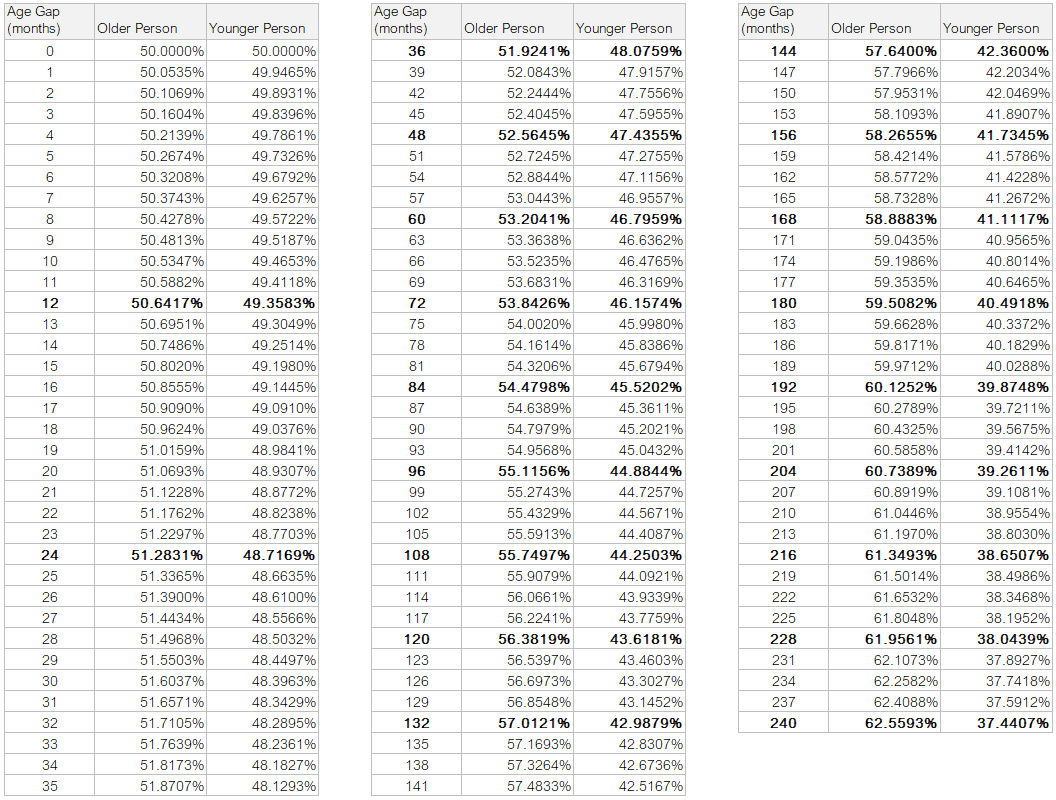
Worked example
Fred is 50 and Sarah is 45, giving us an age gap of 60 months
The corresponding row within the Tables shows that Fred (the older person) needs 53.2041% of the overall pension funds and Sarah (the younger person) needs 46.7959%.
If we assume Fred has £600,000 in a single DC pension and Sarah has £200,000, the overall ‘pot’ we are working with is £800,000.
To calculate the amount of the overall pension each party needs, we use the following method:
Total combined pension funds x suggested percentage = post-sharing target amount
For Fred and Sarah, this would be:
Fred: £800,000 × 53.2041% = £425,633
Sarah: £800,000 × 46.7959% = £374,367
Sarah’s pensions are currently valued at £200,000, so this tells us she needs a pension credit worth £174,367 to achieve the post-sharing target of £374,367.
In this case, since Fred has just one pension worth £600,000, the indicative PSO required against Fred’s £600,000 pension is : £174,367 ÷ £600,000 = 29.06%
Sense check
The Tables are designed to produce the same future fund value at retirement, so it is worthwhile demonstrating how that is achieved.
Currently, the Tables assume a 2.6% real investment return after fees and inflation.
If Fred and Sarah plan to retire at 65, their projected future fund values at retirement would be:
Fred: £425,633 x (1 + 2.6%) ^ 15 years = £625,526
Sarah: £374,367 x (1 + 2.6%) ^ 20 years = £625,525
The £1 projected difference in fund values at retirement is due to rounding.
Since they are both projected to have the same fund value at age 65, if we apply the same retirement assumptions, they would have the same level of illustrative retirement income.
For example, if Fred and Sarah both choose to purchase an annuity in retirement, and if the age 65 annuity rate is 5%, they would both expect to receive £31,276 p.a. of annuity income.
Of course, these projections are not guaranteed. Future growth rates may be higher or lower. It is highly unlikely that both parties investment returns will be the same post-sharing. Actual retirement incomes may differ because of health, product choices, charges and the way each party ultimately accesses their pension.